Federal Tax Credit
November 29, 2022
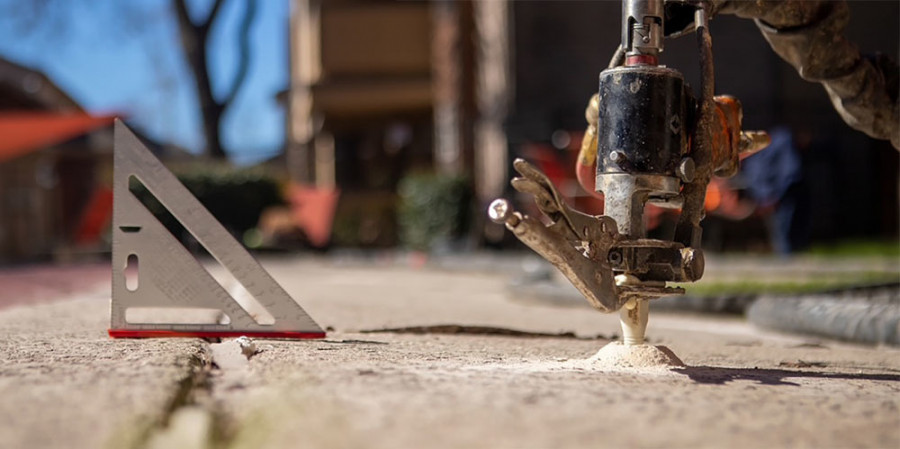
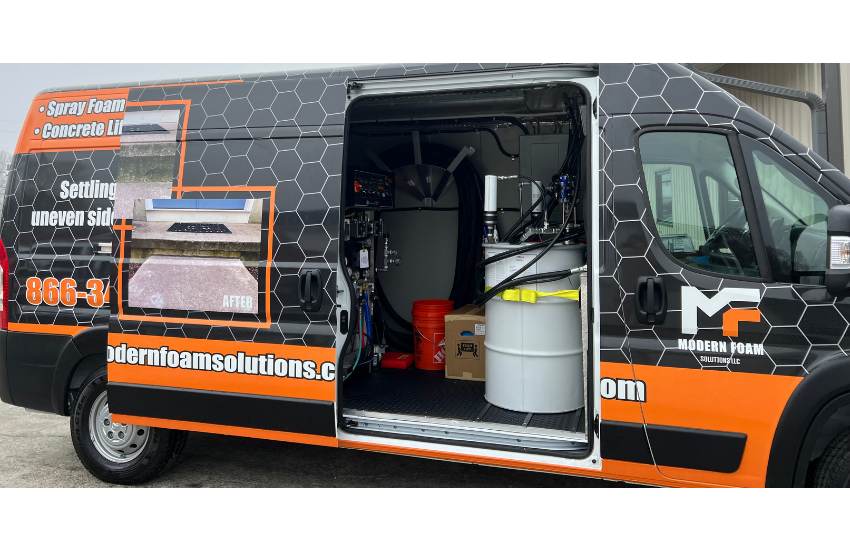
Concrete doesn’t settle "just because". It settles when subgrades lose modulus from fines migration and water pathways, when approach slabs bridge over under-compacted backfill, and when thermal and dynamic loads concentrate at joints until contact is lost. Polyurethane foam injection is uniquely suited to reverse that trajectory. Done correctly, it restores uniform support, re-establishes load transfer, and returns assets to service in hours—not days, with minimal disruption.
A geotechnical polyurethane used for concrete lifting and void filling should travel to the edges of the voids before elevating the slab, knitting cavities together for uniform contact. It should cure to a closed-cell, hydro-insensitive matrix that resists water uptake and maintains properties in damp or saturated soils. And at the installed density, it needs sufficient compressive strength and stiffness to re-establish bearing and load transfer across the slab with controlled elevation.
In practice, that points to water-blown, closed-cell systems with predictable cream/gel windows and strong dimensional stability in service. For precision slab lifting and joint matching, mid-density formulations in the 3–6 pcf free-rise class are common. For big cavities, low-exotherm void fills are used for extended travel and efficient volume recovery at lighter installed densities. The application dictates the formulation, not the other way around.
Anywhere elevation tolerance and uptime matter: bridge approaches and departures, highway and street panels, airport taxiways and aprons, curb-and-gutter transitions, sidewalks and driveways, and foundations. The footprint is small—ports are typically ∼5/8 inch—and the method works in live environments that can only spare brief shutdowns. For owners, that means less disruption and faster reopening. For contractors, it means a controlled, meter-by-meter method that scales.
Precision lifting & load transfer: For approaches, runways/taxiways, warehouse aisles, and joint matching where tolerances are tight, choose a mid density lifting system with a predictable rise profile and robust compressive performance at installed density. For example, TerraThane 24-003 targets slab lifting across transportation and industrial bridge approaches, streets/highways, airport slabs, joint matching, and void filling. The profile suits incremental, controlled lifts where alignment and bearing are critical
Large voids & long flow paths :For undermined approaches, trench breakers, or abandonment scenarios, the priorities are long travel before setting and a manageable exotherm in mass. A formulation such as Strata-Fill 24-039 emphasizes large void filling and abandonment, with slow-reacting, low-exotherm behavior that enhances reach and let’s separate cavities knit before cure.
These are illustrative examples rather than prescriptions. Any equivalent system that matches density, expansion, closed-cell content, and hydro insensitivity for the site conditions is appropriate.
Quality and safety practices that separate pros from the pack:
Three reasons: time, control, and durability. Cure is fast enough to compress outage windows. Metered injection and predictable rise enable fine-grained elevation control in live environments. Closed-cell, hydro insensitive chemistry maintains properties where water and variable soils are a given. Add the small surface footprint, and you have a repeatable method that integrates smoothly with traffic control, flight-line constraints, and warehouse operations. In other words, polyurethane lets you solve the soil problem without creating a schedule problem.
Concrete lifting and void filling with polyurethane foam is no longer a specialty trick. It is a disciplined, data-driven method to restore support and elevation across transportation, aviation, industrial, and municipal assets with minimal downtime. Define the objective, choose a formulation aligned to that objective and to the environmental envelope, then run a tight field process with layered lifts, real-time measurement, and documented acceptance. Do that, and you will consistently deliver panels that are back on grade, back on bearing, and back in service. When precise lift and robust load transfer are paramount, a mid-density lifting formulation is a common fit. When the challenge is long-reach, high-volume voids, a slow-reacting, low-exotherm fill brings the travel and volume efficiency those jobs demand.

November 29, 2022

April 6, 2026

April 2, 2026